Written and medically reviewed by: Dr. Prratyush More, Qualifications, M.B.B.S., D.D.V.L. | Trained in Israel, 2018
Registration No.: 2011/11/3382, Maharashtra Medical Council (MMC) | Prratyush More, Thane
Published: 20, October 2026 | Drafted with AI assistance; reviewed and approved by the author.
Psoriasis often follows a frustrating pattern: it improves with treatment, then flares again weeks or months later. Many people move from cream to cream without a long-term plan. The good news is that our understanding of psoriasis has advanced enormously, and today most people can achieve long-term control, even though there is still no permanent cure.
In brief
|
What psoriasis is
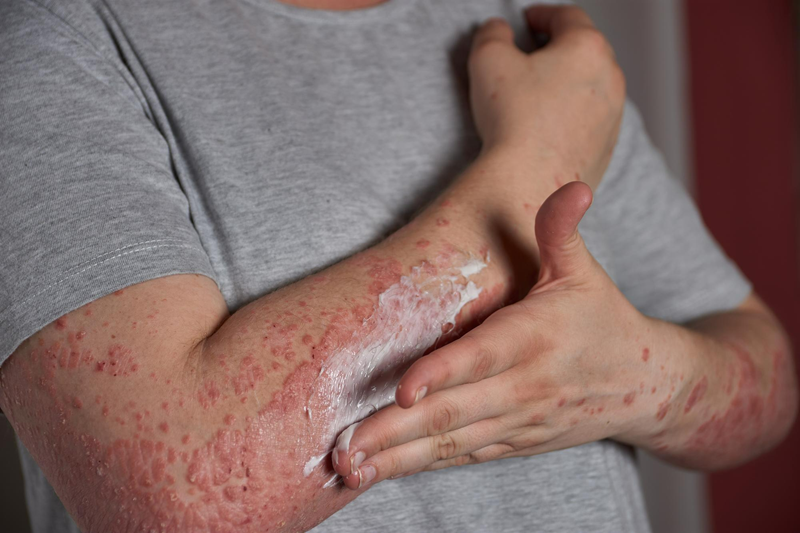
In psoriasis, the immune system becomes overactive. Signalling molecules, especially in the IL-23 and IL-17 pathway, drive inflammation and cause skin cells to multiply far faster than normal. The result is the typical red, thickened, scaly plaques, most often on the elbows, knees, scalp and lower back. Genes play a major role, and psoriasis often runs in families. Studies in India have estimated a prevalence of roughly 0.44% to 2.8%.
Understanding this mechanism has led directly to modern treatments that target these specific immune signals.
Why it keeps flaring
Treatment calms the inflammation, but the underlying tendency remains. Flares often follow a trigger:
- Infections, particularly streptococcal throat infections, which can trigger guttate (drop-shaped) psoriasis
- Stress
- Smoking and alcohol
- Weight gain and obesity, which increase inflammation and can reduce how well treatments work
- Skin injury, such as cuts, scratching or tattoos, where new plaques can appear (the Koebner phenomenon)
- Cold, dry weather
- Certain medicines, including some blood pressure medicines (beta-blockers), lithium and antimalarials. Do not stop any medicine without talking to your doctor.
- Stopping oral or injected steroids. Psoriasis can flare severely, sometimes into widespread or pustular forms, when steroid tablets or injections are stopped. For this reason, oral steroids are generally avoided in psoriasis.
- Stopping effective treatment too early, as soon as the skin clears
What controls psoriasis long term
International guidelines, including those of the American Academy of Dermatology and National Psoriasis Foundation, describe a range of treatments matched to severity, measured using tools such as the body surface area affected, the PASI score and the impact on quality of life. Even limited psoriasis can be considered more severe if it affects the face, scalp, palms, soles, nails or genitals, or significantly affects daily life.
For limited psoriasis: topical treatment
- Topical corticosteroids, often combined with vitamin D analogues such as calcipotriol, are first-line. The combination is more effective and allows less steroid use.
- For the face and skin folds, gentler options such as tacrolimus are often used.
- For some people, scheduled maintenance (for example, applying treatment twice a week to commonly affected areas) can help reduce flares.
- Moisturisers reduce scaling and itching.
For moderate to severe psoriasis
- Phototherapy: narrowband UVB light, usually two to three times a week in a clinic.
- Oral systemic medicines: methotrexate, ciclosporin, acitretin and apremilast. Each requires monitoring and has specific precautions; for example, methotrexate and acitretin must be avoided in pregnancy, and acitretin requires avoiding pregnancy for years after stopping.
- Biologic injections: medicines that block specific immune signals, such as TNF-alpha, IL-17, IL-23 or IL-12/23. Newer biologics targeting IL-17 and IL-23 achieve clear or nearly clear skin in a large proportion of patients in clinical trials. Screening for tuberculosis and hepatitis is needed before starting, which is particularly important in India. Biosimilars, more affordable versions of some biologics, have increased access.
- Newer oral targeted medicines such as TYK2 inhibitors are also available in some countries.
Psoriasis is more than skin
- Psoriatic arthritis affects up to about 30% of people with psoriasis. Signs include joint pain or swelling, morning stiffness, swollen fingers or toes, heel pain and nail changes. Early treatment helps prevent joint damage.
- Psoriasis, especially when severe, is associated with obesity, diabetes, high blood pressure, high cholesterol and heart disease. Regular checks are worthwhile.
- Depression and anxiety are more common in people with psoriasis. Talking about this is part of good care.
What you can do
- Stop smoking and limit alcohol.
- If you are overweight, losing weight can improve psoriasis and how well treatment works.
- Keep skin moisturised and avoid scratching or injuring it.
- Get throat infections assessed, especially if you have had guttate psoriasis.
- Do not stop treatment as soon as the skin clears; ask your dermatologist about a maintenance plan.
- Be cautious about any claim of a “permanent cure”. There is currently no cure, but long-term control is realistic.
When to see a dermatologist
- Psoriasis that keeps returning despite creams, or covers a large area
- Psoriasis on the scalp, face, palms, soles, nails or genitals that affects daily life
- Joint pain, swelling or stiffness
- Urgently: widespread redness over most of the body, pus-filled spots with fever, or feeling unwell
Important note
This article is for general health education only. It is not a substitute for an in-person consultation, diagnosis or treatment. The suitability and results of any treatment vary from person to person, and no treatment can promise a particular outcome. Please consult a qualified Registered Medical Practitioner about your own situation.
About the author: Dr. Prratyush More, Qualifications: M.B.B.S., D.D.V.L. | Trained in Israel, 2018, Registration No. 2011/11/3382 (Maharashtra Medical Council (MMC).
References
- Griffiths CEM, Armstrong AW, Gudjonsson JE, Barker JNWN. Psoriasis. Lancet. 2021;397(10281):1301–1315.
- Menter A, Strober BE, Kaplan DH, et al. Joint AAD-NPF guidelines of care for the management and treatment of psoriasis with biologics. J Am Acad Dermatol. 2019;80(4):1029–1072.
- Menter A, Gelfand JM, Connor C, et al. Joint AAD-NPF guidelines of care for the management of psoriasis with systemic nonbiologic therapies. J Am Acad Dermatol. 2020;82(6):1445–1486.
- Elmets CA, Korman NJ, Prater EF, et al. Joint AAD-NPF guidelines of care for the management and treatment of psoriasis with topical therapy and alternative medicine modalities for psoriasis severity measures. J Am Acad Dermatol. 2021;84(2):432–470.
- Dogra S, Yadav S. Psoriasis in India: prevalence and pattern. Indian J Dermatol Venereol Leprol. 2010;76(6):595–601.