
― NAIL SURGERY
Expert Nail Surgery &
Nail Disorder Treatment
Comprehensive surgical and medical management of all nail conditions — from painful ingrown nails to complex nail dystrophies. Painless procedures under digital nerve block with permanent results.
Ingrown Nail SurgeryNail InfectionsNail DystrophyNail Pigmentation
Why patients choose Dr. Prratyush More
✓ Painless Digital Nerve Block
Complete anaesthesia — procedure is entirely pain-free
✓ Permanent Cure in Some Nail Conditions
Matrix phenolisation prevents ingrown nail recurrence
✓ Lab Confirmation Before Antifungals
KOH microscopy before every antifungal prescription
✓ Onychoscopy Diagnostics
Advanced nail unit dermoscopy for accurate diagnosis
― WHAT IS IT
What are Nail Disorders?
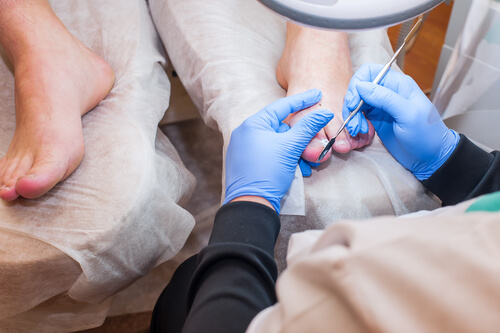
Nail disorders encompass conditions affecting the nail plate, nail bed, nail matrix, and surrounding periungual tissues — ranging from common ingrown toenails to complex nail dystrophies requiring surgical intervention. Nails are clinically important: they reflect systemic disease, can be the site of malignancy, and significantly impact daily function and quality of life.
Nail conditions are frequently undertreated or misdiagnosed. Onychomycosis in particular is prone to misdiagnosis — many non-fungal nail conditions are incorrectly treated with antifungals for months without result. At Dr. More’s clinic, onychoscopy and laboratory confirmation ensure accurate diagnosis before treatment begins.
Toenails & Fingernails · Surgical & Medical Management
Complete nail care — from acute infections and ingrown nails to complex dystrophies and pigmented lesions — managed by a experienced dermatologist.
― CONDITIONS WE TREAT
Nail Conditions Treated
From the extremely common — ingrown nails, fungal infections — to the surgically complex and diagnostically challenging.
Ingrown Toenail (Onychocryptosis)
Most common nail condition — permanent surgical cure available.
Ingrown Toenail (Onychocryptosis)
The nail edge grows into surrounding flesh, causing severe pain, swelling, and recurrent infection. Most common in the big toe. Treated conservatively for mild cases; surgically with lateral nail avulsion and matrix phenolisation for moderate-severe cases — achieving a permanent cure with over 95% success rate in a single session under digital nerve block.
Onychomycosis (Fungal Nail Infection)
Lab-confirmed diagnosis before any antifungal treatment.
Onychomycosis (Fungal Nail Infection)
Fungal nail infection affecting approximately 10% of the population — causing thickening, discolouration, and crumbling of the nail. Must be confirmed with KOH microscopy before starting oral antifungals, which carry hepatic side effects. Dr. More confirms diagnosis with laboratory testing before prescribing systemic treatment.
Paronychia (Nail Fold Infection)
Acute bacterial or chronic candidal infection — correctly treated.
Paronychia (Nail Fold Infection)
Acute bacterial paronychia presents with a painful, swollen nail fold and may require incision and drainage under local anaesthesia. Chronic paronychia — typically caused by candidal infection and wet work exposure — requires a completely different management approach. Correct differentiation of the two prevents treatment failure.
Nail Dystrophy & Nail Biopsy
Nail deformity, ridging, thickening — causes identified and treated.
Nail Dystrophy & Nail Biopsy
Nail deformity, ridging, thickening, pitting, or discolouration with multiple possible causes — psoriasis, lichen planus, fungal infection, trauma, or systemic disease. Onychoscopy distinguishes causes and guides management. Nail biopsy under digital nerve block is performed when a definitive histopathological diagnosis is required.
Periungual & Subungual Warts
Viral warts around and under the nail — combination treatment.
Periungual & Subungual Warts
Viral warts around and under the nail are notoriously difficult to treat and can cause significant nail deformity. Combination approaches using electrocautery, chemical destruction, and immunotherapy achieve effective clearance. Complete removal is essential to prevent deep nail matrix damage and permanent dystrophy.
Nail Pigmentation & Melanonychia
Pigmented nail streaks — dermoscopy excludes malignancy.
Nail Pigmentation & Melanonychia
Pigmented nail streaks (melanonychia striata) require careful evaluation to exclude subungual melanoma — the most serious cause of nail pigmentation. Dr. More performs onychoscopic assessment of every pigmented nail lesion and selects cases for nail biopsy when clinically indicated. Early diagnosis is life-saving.
Subungual Haematoma
Blood under the nail — drainage relieves pain immediately.
Subungual Haematoma
A collection of blood under the nail following trauma — causing intense throbbing pain. Trephination (creating a small hole in the nail plate) immediately relieves the pressure and pain. Underlying fractures are excluded when clinically indicated. Large or extensive haematomas may require nail plate removal for assessment.
Nail Psoriasis
Pitting, onycholysis, subungual hyperkeratosis — specialist management.
Nail Psoriasis
Nail involvement occurs in up to 50% of psoriasis patients, causing pitting, onycholysis, subungual hyperkeratosis, and oil-drop discolouration. Nail psoriasis frequently mimics onychomycosis — accurate differential diagnosis prevents ineffective antifungal treatment. Management is coordinated with systemic psoriasis treatment.
Nail Avulsion & Nail Surgery for Trauma
Post-traumatic nail conditions — reconstructive surgical approach.
Nail Avulsion & Nail Surgery for Trauma
Traumatic nail loss, nail bed injuries, nail plate avulsion, and post-traumatic nail deformity requiring surgical assessment and management. Nail bed repair, wound management, and appropriate dressing protect the matrix and optimise regrowth. Post-traumatic nail dystrophy is assessed onychoscopically for long-term management planning.
― OUR PROCESS
How Every Nail Condition Is Assessed & Treated?
A systematic, safety-first approach — from onychoscopic assessment to post-operative recovery guidance.
01
Assessment
Clinical Examination & Onychoscopy
Comprehensive clinical examination of the affected nail(s) including onychoscopic assessment. Onychoscopy visualises nail plate, nail bed, and matrix structures in detail — providing significantly more diagnostic information than naked-eye examination alone. Every nail condition is assessed before any procedure is planned.
02
Investigation
Laboratory Confirmation When Indicated
KOH microscopy and fungal culture for suspected onychomycosis — performed before any antifungal prescription. Oral antifungals carry hepatic side effects and should only be prescribed when fungal infection is confirmed. This principle protects patients from unnecessary systemic medication and prevents treatment failure.
03
Anaesthesia
Digital Nerve Block — Completely Painless
Local anaesthetic injected at the base of the digit renders it completely numb from the base. The procedure site is tested for complete anaesthesia before any surgical instrument is used. Patients are frequently surprised at how painless nail surgery is — the anaesthetic injection itself is the most uncomfortable part.
04
Surgery
Precision Nail Surgical Procedure
Technique selected based on the condition — partial nail avulsion with phenolisation for ingrown nails, nail biopsy for diagnostic uncertainty, complete avulsion for severe onychomycosis, trephination for haematoma, or wart excision. Each technique is performed with precision to achieve the objective and minimise healing time.
05
Post-Op Care
Wound Care & Recovery Guidance
Post-operative care instructions including dressing technique, activity restrictions, footwear advice, and expected healing timeline — provided in writing on the day of surgery. Suture removal appointment scheduled where applicable. Dr. More’s team is accessible between visits for any post-operative concern.
― SURGICAL OUTCOMES
What You Can Expect?
Permanent cure for ingrown nails, accurate diagnosis before antifungal treatment, healthy nail regrowth, and early detection of pigmented lesions.
Permanent Ingrown Nail Resolution
Lateral matrix phenolisation achieves a permanent cure in over 95% of cases — preventing regrowth of the offending nail edge. One procedure, lasting relief.
Healthy Nail Regrowth
With correct surgical technique and meticulous post-operative care, nails regrow in healthy form. Toenail regrowth takes 12–18 months — complete guidance is provided for the full recovery period.
Accurate Diagnosis of Pigmented Lesions
Onychoscopic assessment identifies cases requiring biopsy — enabling early diagnosis of subungual melanoma and preventing unnecessary biopsy of clearly benign lesions.
Confirmed Diagnosis Before Treatment
Laboratory confirmation of onychomycosis prevents unnecessary oral antifungal treatment of non-fungal nail conditions — protecting you from systemic medication you don’t need.
Healthy Nail Regrowth
With correct surgical technique and meticulous post-operative care, nails regrow in healthy form. Toenail regrowth takes 12–18 months — complete guidance is provided for the full recovery period.
Accurate Diagnosis of Pigmented Lesions
Onychoscopic assessment identifies cases requiring biopsy — enabling early diagnosis of subungual melanoma and preventing unnecessary biopsy of clearly benign lesions.
― WHY DR. PRRATYUSH MORE
Why Choose Us for Nail Surgery & Nail Disorders?
Onychoscopy, lab confirmation, painless nerve block, permanent cure techniques — specialist nail care in Vasant Vihar, Thane West.
Specialist Nail Surgery.
Permanent Results.
Nail disorders require the dual expertise of a dermatologist who understands nail pathology in depth and a surgeon with precision technique. Dr. Prratyush More combines both — bringing specialist nail diagnostics, surgical precision, and meticulous post-operative care to every nail procedure at his Vasant Vihar, Thane West clinic.
Experienced Dermatologist
Comprehensive training in nail surgery and nail disease. Dermatologists have specific nail expertise that general surgeons and GPs lack — anatomical knowledge of nail unit structures, surgical precision, and post-operative nail management.
Onychoscopy — Advanced Nail Diagnostics
Dermoscopy of the nail unit enables non-invasive assessment of nail plate, bed, and matrix structures — significantly improving diagnostic accuracy for pigmented lesions, psoriasis, fungal infection, and other nail disorders.
Laboratory Confirmation for Fungal Nails
KOH microscopy before any antifungal prescription. Oral antifungals have hepatic side effects and should only be prescribed when fungal infection is laboratory-confirmed. This is standard at our clinic — not the exception.
Painless Digital Nerve Block Technique
Expert administration of digital ring block ensures complete, reliable, pain-free anaesthesia before every nail surgical procedure. Patients are consistently surprised by how completely painless nail surgery is in experienced hands.
Permanent Recurrence Prevention
Lateral matrix phenolisation for ingrown nails achieves permanent cure in over 95% of cases. Techniques are chosen for long-term effectiveness — not just short-term relief that leads to rapid recurrence.
Complete Post-Operative Support
Written wound care instructions, follow-up appointment, and active accessibility between visits. You are never left managing a post-surgical nail without clear, accessible support from diagnosis to full recovery.
― COMMON QUESTIONS
Frequently Asked Questions
Answers to the questions patients ask most frequently about nail surgery and nail disorder treatment at our clinic.
Is ingrown nail surgery painful?
No. Nail surgery is performed under digital nerve block — once the local anaesthetic takes effect, the procedure is completely painless. The injection of local anaesthetic itself involves a brief stinging sensation, but the procedure that follows is pain-free. Most patients are surprised by how comfortable the experience is. Post-operative pain is mild and typically managed with standard oral analgesics for 24–48 hours.
Will my ingrown nail grow back after surgery?
This depends on the technique used. Simple nail avulsion without matrix ablation has a high recurrence rate. Lateral nail avulsion combined with phenolisation of the nail matrix — Dr. More’s standard technique for recurrent or severe ingrown nails — achieves permanent resolution in over 95% of cases by permanently destroying the portion of the nail matrix responsible for the offending nail edge.
How long does recovery take after ingrown nail surgery?
Most patients walk comfortably within 24–48 hours of surgery with standard footwear — or open-toe footwear in the first few days. The surgical site heals over 3–6 weeks. Complete nail regrowth takes 12–18 months for toenails. Detailed post-operative instructions covering dressing changes, activity, bathing, and footwear are provided in writing on the day of surgery.
I have been using antifungal cream for months with no result — what should I do?
Topical antifungals have very limited penetration through the nail plate and are generally ineffective for established onychomycosis involving the nail bed. Effective treatment requires oral antifungal therapy — but only after laboratory confirmation of fungal infection. Many nail conditions mimic fungal infection. Dr. More performs KOH microscopy to confirm diagnosis before prescribing systemic treatment, which requires liver function monitoring.
I have a dark streak in my nail — is this serious?
A pigmented nail streak (melanonychia) has multiple causes — the majority are benign racial melanonychia, nail matrix naevus, or medication-related pigmentation. However, subungual melanoma — a serious but rare condition — also presents as a pigmented nail streak. Onychoscopic assessment identifies features that distinguish benign from suspicious lesions. Dr. More assesses every pigmented nail lesion and selects cases for biopsy based on clinical and onychoscopic criteria.
Can nail fungus be treated without oral medication?
Mild, superficial onychomycosis affecting only the nail surface may respond to topical antifungal lacquers (amorolfine or ciclopirox). However, nail bed or matrix involvement — which is present in most established cases — requires oral antifungal therapy for effective treatment. The choice between topical and systemic treatment depends on the extent, severity, and causative organism, established by laboratory testing.
What is the difference between a nail biopsy and nail avulsion?
Nail avulsion is the surgical removal of part or all of the nail plate — used for ingrown nails, severe onychomycosis, or haematoma. Nail biopsy is the removal of a small tissue sample from the nail bed, matrix, or surrounding tissue for histopathological examination — used to diagnose nail tumours, unusual pigmentation, or conditions not identifiable by clinical examination. Both are performed under digital nerve block and are painless.
Can children have nail surgery?
Yes. Ingrown toenails are common in children and teenagers and can cause significant pain and recurrent infection. Nail surgery under digital nerve block is safe and effective in children. For younger children, the procedure is explained in child-appropriate language and the approach is adapted to minimise anxiety. In some cases, depending on age and anxiety level, the procedure may be performed under sedation — which Dr. More discusses at consultation when relevant.
― Patient Stories
Trusted by Our Patients
Real experiences from real patients in Thane. Here’s what they say about their journey with Dr. Prratyush More.