Dr. Prratyush More — Dermatologist & Hair Restoration Specialist, Thane
completed training in Israel under Dr. Alex Ginzburg in hair loss treatment and hair
transplant surgery. He practises across three clinics — KP Dermatology (skin care,
aesthetics and laser), Pristine Radiance (laser hair reduction) and Roots Restore (hair loss
treatment and hair transplantation).
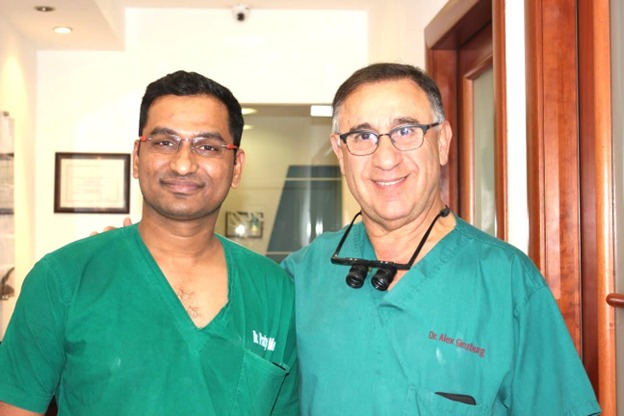
Dr. Prratyush More with Dr. Alex Ginzburg, in Israel in 2018
Dr. Prratyush More
M.B.B.S., D.D.V.L. | Trained in Israel, 2018
Maharashtra Medical Council (MMC) –
Registration No. 2011/11/3382
Three Specialized Verticals, Thane
14+ Years Clinical Experience
Training & Professional Background
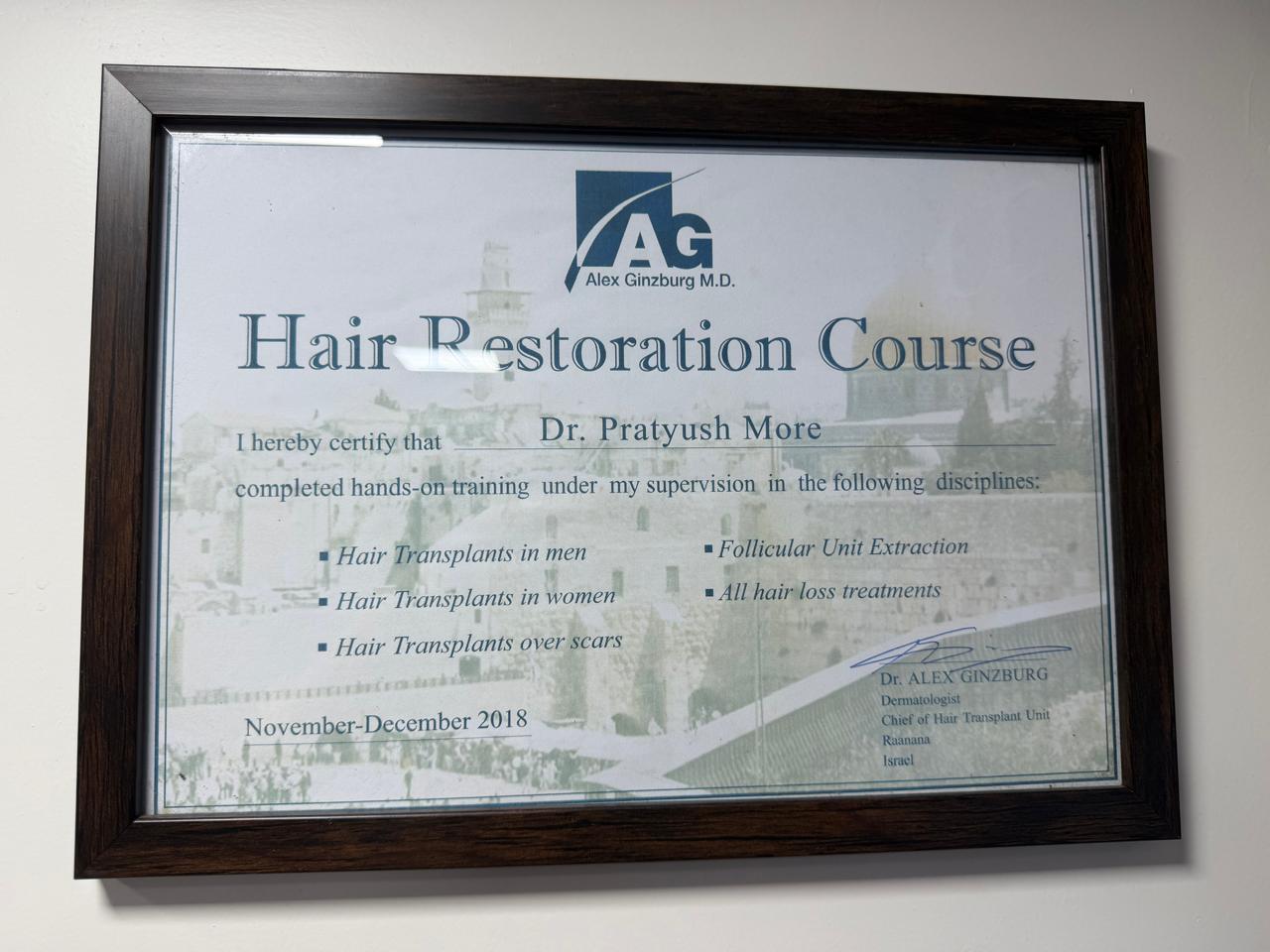
In 2018, Dr. Prratyush More trained in Israel under Dr. Alex Ginzburg in hair loss treatment and hair transplant surgery. The training was clinical and surgical in nature and covered:
Follicular Unit Extraction (FUE) technique — graft extraction and implantation methodology
Hairline design — principles of angle, direction, density gradation and irregularity in natural hairline construction
Graft handling and survival — extraction-to-implantation intervals, holding solutions and atraumatic handling protocols
Medical evaluation of hair loss — clinical assessment of androgenetic alopecia, telogen effluvium, alopecia areata and female pattern hair loss prior to considering surgery Long-term surgical planning — accounting for the progressive nature of pattern hair loss when planning graft placement
Why training matters in hair restoration
Hair transplantation is a surgical procedure and its result is permanent. Outcomes depend substantially on surgical judgement, hairline design and follicle handling technique. Dr. More’s training in Israel was directed specifically at these aspects of the procedure.
Outcomes in hair restoration vary between individuals and depend on the extent and pattern of hair loss, donor availability, age, medical history and adherence to post-operative care. No specific result can be assured in advance.
The Three Clinics
Dr. More’s practice is organised across three separate clinical facilities, each with its own equipment and clinical protocols.
KP DERMATOLOGY
Skin Care, Aesthetics & Laser Centre
Medical dermatology and dermatologic aesthetics: acne, acne scarring, pigmentary disorders including melasma, skin ageing, eczema, psoriasis, fungal and other skin conditions, chemical peels, microneedling, HydraFacial, medi-facials and laser skin procedures.
PRISTINE RADIANCE
Laser Hair Reduction Clinic
A facility dedicated to laser hair reduction, for facial and body areas, in both women and men.
ROOTS RESTORE
Hair Loss Treatment & Hair Transplant Clinic
Trichological evaluation, medical management of hair loss, growth factor and mesotherapy procedures, and FUE hair transplant surgery.
Equipment & Technology
The following systems are in clinical use across the three centres. Each is listed with its
manufacturer, country of origin, and the conditions for which it is used. Suitability of any device for an individual patient is determined at clinical consultation.
Candela PicoWay with 1064nm Resolve Handpiece — Candela Corporation, USA
Conditions for which it is used:
- Melasma — the 1064nm Resolve fractional handpiece is used in selected cases as part of a combined protocol
- Solar lentigines, sun-induced pigmentation and freckles
- Post-inflammatory hyperpigmentation
- Acne scarring — Resolve creates sub-surface laser-induced optical breakdown zones to stimulate dermal remodelling while leaving the epidermis intact
- Skin texture, enlarged pores and photoageing
- Tattoo removal, including multi-coloured and previously treated tattoos
- Dermal melanocytosis — nevus of Ota, Hori’s nevus
Melasma is a chronic, relapsing condition. Laser treatment forms one part of a longer-term management plan that includes photoprotection and medical therapy, and recurrence is possible.
Candela GentleMax Pro with Vascular Handpiece — Candela Corporation, USA - (Coming Soon)
A dual-wavelength platform combining 755nm Alexandrite and 1064nm Nd:YAG, with a cryogen-based Dynamic Cooling Device that cools the epidermis immediately before each pulse.
Conditions for which it is used:
- Laser hair reduction — 755nm for lighter skin phototypes and finer hair; 1064nm for darker skin phototypes and coarser hair
- Vascular lesions, using the dedicated vascular handpiece:
- Facial telangiectasia and broken capillaries
- Rosacea-associated erythema and facial flushing
- Cherry angiomas
- Leg veins and superficial venulectasia
- Port wine stains and vascular birthmarks
- Poikiloderma of Civatte
- Post-acne erythema
- Photoageing and sun-induced pigmented lesions
Alma Soprano Titanium Special Edition — Alma Lasers, Israel
A hair reduction platform that emits 755nm, 810nm and 1064nm simultaneously through a single applicator, targeting follicular structures at differing depths. It uses contact cooling and an in-motion, gradual-heating delivery technique, which is generally better tolerated than single-pulse, high-fluence methods.
Areas and indications treated:
- Facial hair reduction — upper lip, chin, sideburns, cheeks, full face
- Underarms, arms, legs, back, chest, abdomen
- Bikini and Brazilian areas
- Beard-line shaping and body hair reduction in men
- Hirsutism associated with PCOS, as part of overall medical management
- Pseudofolliculitis barbae, ingrown hairs and recurrent folliculitis
- Suitable for a broad range of skin phototypes, including darker and tanned skin, subject to clinical assessment
Laser hair reduction reduces hair density and thickness over a course of sessions. It is not a single-session procedure, results differ between individuals, and periodic maintenance sessions are usually required. Hormonal conditions can affect response.
Fotona TimeWalker 4D — Fotona, Slovenia (Europe) - (Coming Soon)
A dual-wavelength system combining Er:YAG (2940nm) and Nd:YAG (1064nm), delivered in four sequential modes within the Fotona4D protocol:
1. SmoothLiftin — intraoral Er:YAG application treating the perioral region from the inner surface
2. FRAC3 — fractional Nd:YAG targeting deeper dermal irregularities
3. PIANO — bulk dermal heating for dermal tightening
4. SupErficial — light Er:YAG epidermal resurfacing
Conditions for which it is used:
- Skin laxity of the lower face, jawline and neck
- Fine lines, wrinkles and nasolabial folds
- Acne scarring — Er:YAG ablative and fractional resurfacing for boxcar and rolling scars
- Enlarged pores and irregular skin texture Striae (stretch marks) and surgical or post-traumatic scars
- Periorbital skin ageing
- NightLase — a non-invasive Er:YAG protocol used as an adjunct in snoring, following appropriate clinical evaluation
Degree of tightening varies with age, skin quality and baseline laxity. It is not equivalent to surgical facelifting.
HydraFacial Syndeo — BeautyHealth, USA
A device-based facial procedure using a spiral-tip vacuum system to perform cleansing, exfoliation, painless extraction and simultaneous infusion of topical serums.
Used for:
- Comedonal and congested acne-prone skin, for atraumatic extraction
- Dehydrated and dull skin
- Early pigmentary irregularity, with brightening serums
- Enlarged pores and seborrhoea
- Early skin ageing, with peptide-based serums
- Sensitive or reactive skin, where mechanical procedures are poorly tolerated
Effects are cumulative and largely temporary. Repeat sessions are required to maintain results.
Dermapen 4 — DermapenWorld, Australia
A motorised, vertically oscillating microneedling device with adjustable needle depth up to 3.0mm. Vertical needle entry produces defined micro-channels with less epidermal tearing than rolling devices.
Used for:
-
Atrophic acne scarring — rolling and boxcar scars, frequently combined with subcision
-
Enlarged pores and irregular texture
-
Striae distensae (stretch marks)
-
Post-surgical and post-traumatic scars
-
Fine lines and early dermal laxity
-
Melasma and pigmentation, using specific low-depth protocols
-
Combined with PRP or GFC where clinically indicated
-
Scalp microneedling as an adjunct in the management of androgenetic alopecia
Multiple sessions at intervals of 4–6 weeks are typically required. Scar improvement is partial; complete resolution of scarring is not achievable by any modality.
Obagi Medi-Facials and Medical Skincare — Obagi, USA
Obagi is a prescription-strength dermatological skincare range dispensed under medical supervision. Dr. More uses Obagi protocols and medi-facial procedures as part of structured treatment plans.
Used for:
-
Melasma and other pigmentary disorders, within a combined medical protocol
-
Acne and post-acne pigmentation
-
Photoageing and sun-induced damage
-
Uneven skin tone and dullness
-
Skin preparation before, and maintenance after, laser procedures — a step that materially affects safety in skin of colour
Prescription-strength topical agents require medical supervision and may cause irritation, dryness or peeling during the initial phase.
Acne scar treatment produces graded improvement over multiple sessions spaced several weeks apart. No modality removes scarring completely, and the degree of improvement depends on scar type, depth, duration and individual healing.
Coming soon from Germany 🇩🇪
The FotoFinder medicam 1000s with Universe 3.5 and Trichoscale AI
FotoFinder medicam 1000s with Universe 3.5 and Trichoscale AI — FotoFinder Systems GmbH, Germany
The medicam 1000s is a high-end video dermoscopy camera for skin, hair, and nails, delivering brilliant image quality with up to 400x optical magnification. Paired with FotoFinder Universe 3.5, an AI-powered software platform, it adds MoleGallery lesion tracking and AIMEE real-time AI risk scoring to mole and skin screening, while the Trichoscale AI module brings automated, AI-based quantification of hair growth and hair loss to trichoscopy assessments.
Will be used for:
-
AI-assisted mole and skin lesion screening with real-time risk scoring (AIMEE)
-
Longitudinal mole tracking and follow-up documentation (MoleGallery)
-
Quantitative hair growth and hair loss analysis for androgenetic alopecia and hair transplant assessment (Trichoscale AI)
-
High-magnification dermoscopy, trichoscopy, and nail (onychoscopy) examination
This system is currently being onboarded at the clinic and will be available for patient examinations shortly.
Conditions Treated
Hair Loss Treatment — Thane West
Hair fall is a presenting symptom, not a diagnosis. At Roots Restore, evaluation precedes treatment.
Assessment includes: clinical history including family pattern, duration, medication, illness and nutritional factors . digital trichoscopy . pull test and scalp examination . blood investigations where indicated (thyroid profile, serum ferritin, Vitamin D, Vitamin B12, hormonal profile). Norwood or Ludwig grading.
Conditions managed: androgenetic alopecia (male and female pattern) . telogen effluvium. alopecia areata . post-partum hair loss. post-illness hair loss . traction alopecia. seborrhoeic dermatitis and dandruff-associated hair fall . diffuse thinning.
Treatment options, selected according to diagnosis:
- Growth Factor Concentrate (GFC) and Platelet-Rich Plasma (PRP) therapy
- Dutoxome mesotherapy
- Scalp microneedling
- Prescription topical and oral medical therapy
- Nutritional correction where a deficiency is identified
- FUE hair transplant surgery, where medical therapy alone is unlikely to meet the clinical objective
Response to medical treatment for hair loss varies between individuals, generally takes 3–6 months to become apparent, and usually requires ongoing therapy. Not every form of hair loss is reversible.
Hair Transplant Surgery — Thane West
Hair transplantation is a day-care surgical procedure performed under local anaesthesia, in which follicular units are relocated from a donor area to areas of loss.
Procedures performed at Roots Restore:
- Growth Factor Concentrate (GFC)
- FUE hair transplantation — scalp
- Beard and moustache transplantation
- Eyebrow transplantation
- Temple and frontal hairline reconstruction
- Corrective hair transplantation
- Hair transplantation in female pattern hair loss, in selected cases
Clinical pathway: consultation, trichoscopy and graft estimation → pre-operative investigations → surgery (day-care) → post-operative review at 24–48 hours → follow-up at 1, 3, 6, 9 and 12 months.
Important information about hair transplantation: Transplantation redistributes existing hair; it does not create new follicles or increase total hair count. It does not halt ongoing loss of native, untransplanted hair, and continued medical therapy is usually advised alongside.
Visible growth typically begins around 3–4 months, with the result maturing over 12–18 months. As with any surgical procedure, there are risks, including bleeding, infection, swelling, temporary shock loss, folliculitis and variability in graft survival. These are discussed in full during consultation and informed consent is obtained before surgery.
Laser Hair Reduction — Pristine Radiance, Thane West
Laser hair reduction targets melanin within the hair follicle to reduce hair growth over a course of treatments. Procedures are carried out on the Alma Soprano Titanium (Israel) and Candela GentleMax Pro (USA) systems, with the wavelength and settings selected according to skin phototype and hair characteristics.
Areas Treated:
-
upper lip . chin . full face . underarms . arms . legs . bikini and Brazilian . back . chest . abdomen . full body . beard-line shaping.
What to expect: A typical course is 6–8 sessions at 4–6 week intervals, with periodic maintenance sessions thereafter. Hair reduction is progressive rather than immediate, and complete permanent removal of all hair is not achievable. Response depends on hair colour and thickness, skin phototype, hormonal status and underlying conditions such as PCOS.
Grey, white and very fine light hair responds poorly, as it contains little melanin. Possible side effects include transient redness, perifollicular oedema and, uncommonly, pigmentary change or blistering.
All sessions are performed under the supervision of a qualified dermatologist.
Pigmentation and Melasma Treatment — Thane West
Conditions managed:
- Melasma
- Solar lentigines and sun-induced pigmentation
- Freckles
- Post-inflammatory hyperpigmentation following acne, injury or hair removal
- Periorbital melanosis (dark circles)
- Acanthosis nigricans and pigmentation of the neck, axillae, elbows and knees
- Dermal melanocytosis including nevus of Ota and Hori’s nevus
- Pigmented lesions, following clinical and dermoscopic evaluation
Clinical approach: diagnosis first, using Wood’s lamp and dermoscopy to determine whether pigment is epidermal, dermal or mixed, and to identify contributing factors such as sun exposure, hormonal influences, thyroid dysfunction or cosmetic products. Management then combines strict photoprotection, prescription topical therapy including Obagi medical skincare, chemical peels, and laser sessions using the PicoWay Resolve handpiece where indicated, followed by long-term maintenance.
Melasma in particular is a chronic and relapsing condition. Treatment aims at lightening and control rather than cure, recurrence is common, especially with sun exposure and hormonal change, and long-term maintenance is necessary. Inappropriate laser treatment can worsen melasma, which is why device selection and staging matter.
Acne and Acne Scar Treatment — Thane West
Active acne is treated medically before scar revision is undertaken, since treating scars in the presence of active inflammatory acne can generate further scarring.
Management includes:
- Evaluation of hormonal, dietary and cosmetic contributors, and investigation for PCOS where indicated
- Prescription topical and oral therapy, including isotretinoin in appropriate cases with counselling and monitoring
- Comedone extraction
- Intralesional therapy for nodulocystic lesions
- Chemical peels, including Obagi Blue Peel Radiance
- HydraFacial for congested skin
Skin Ageing and Rejuvenation — Thane West
Non-surgical management of skin laxity, fine lines, wrinkles, submental fullness, uneven texture and photoageing.
Technologies used:
- Fotona TimeWalker 4D
- Dermapen 4 microneedling
- HydraFacial Syndeo
- Obagi medical skincare
Results are gradual, vary with age and skin quality, and require maintenance. These procedures are not substitutes for surgical intervention where surgery is indicated.
General and Medical Dermatology — Thane West
- Eczema and atopic dermatitis
- Psoriasis
- Vitiligo
- Fungal infections
- Urticaria and drug reactions
- Contact and allergic dermatitis
- Rosacea
- Warts, molluscum, skin tags and dermatosis papulosa nigra
- Nail disorders
- Keloids and hypertrophic scars
- Scabies
- Paediatric dermatological conditions
- Evaluation of moles and pigmented lesions
Consultation Process
What a Consultation Involves
Clinical History
Relevant medical history, medication and family history are reviewed as part of the initial assessment.
Diagnostic Assessment
Dermoscopy, trichoscopy or Wood’s lamp examination as required, with blood investigations where clinically indicated.
Diagnosis & Discussion
The condition, its natural course, and the available options — including the option of no intervention.
Informed Consent
Expected outcomes, limitations, risks and alternatives are explained before any procedure begins.
Treatment Plan
A written plan is provided, including the number of sessions anticipated and the follow-up schedule.
We Offer 9 Dermatology Subspecialities
From everyday skin concerns to advanced hair restoration — specialised care across 9 disciplines, all under one roof.
Dermatology
Dermatology
Cosmetic Dermatology
Cosmetic Dermatology
Trichology
Trichology
Pediatric Trichology
Pediatric Trichology
Dermato-Surgery
Dermato-Surgery
Pediatric Dermatology
Pediatric Dermatology
Nail Treatments & Surgery
Nail Treatments & Surgery
Venereology & STD's
Venereology & STD's
Hair Transplant
Hair Transplant Surgery
Consultation Fees
Transparent consultation fees across dermatology, trichology and hair transplant care — book the consultation that fits your concern. Procedure charges, if required, will be additional.
Important Notice Regarding Wait Times
To help you better plan your visit, we want to kindly inform you that waiting times at the clinic can range from 30 minutes to 3 hours. Because dermatology involves highly personalized care, some consultations, planned procedures, or unexpected medical emergencies can take a little longer than anticipated.
We never want to rush our patients and strive to give everyone thorough attention. We kindly request your patience and cooperation, and invite you to bring a book or a device to keep you comfortable while you wait.
Clinical Dermatology Consultation
Aesthetic / Cosmetic Dermatology Consultation
Aesthetic Dermatology Consultation + Dermascopy
Hair Loss Consultation
Hair Loss Consultation + Trichoscopy
Pediatric Dermatology Consultation
Laser Hair Removal Consultation
Dermato-Surgery Consultation
Nail Surgery Consultation
Venereology / STDs / STIs Consultation
FUE Hair Transplant Consultation
- *Separate Charges: Each of the above-mentioned consultations will be charged separately.
- *Trichoscopy & Dermascopy by FotoFinder medicam 1000s with Universe 3.5 and Trichoscale AI — FotoFinder Systems GmbH, Germany
Serving International Patients & NRIs
Dr. Prratyush More welcomes patients from across the globe for advanced hair transplant and dermatology treatments at internationally benchmarked care and accessible costs.
🇺🇸 USA · 🇬🇧 UK · 🇩🇪 Germany · 🇦🇺 Australia · 🇸🇬 Singapore · 🇦🇪 Dubai
Video Pre-Consultations
Detailed Treatment Planning
Post-Travel Follow-Up Support
Frequently Asked Questions
Where did Dr. Prratyush More train in hair transplantation?
Dr. More trained in Israel in 2018 under Dr. Alex Ginzburg, in hair loss treatment and hair transplant surgery. The training covered FUE technique, hairline design, graft handling protocols and the medical evaluation of hair loss.
Which clinics does Dr. More practise at?
Three: KP Dermatology (skin care, aesthetics and laser), Pristine Radiance (laser hair reduction), and Roots Restore (hair loss treatment and hair transplantation), all in Thane West.
Is laser hair reduction permanent?
No method achieves complete permanent removal of all hair. Laser treatment produces a progressive reduction in hair density and thickness over a course of sessions, typically 6–8, with periodic maintenance thereafter. Response varies with hair colour, skin type and hormonal status.
Is laser hair reduction suitable for Indian skin?
Suitability depends on skin phototype and is assessed at consultation. The systems in use include 1064nm Nd:YAG wavelengths, which are generally considered appropriate for darker phototypes, and settings are selected individually.
Can melasma be cured?
Melasma is a chronic, relapsing condition. Treatment aims at lightening and long-term control rather than cure. Recurrence is common, particularly with sun exposure and hormonal change, and maintenance therapy is required.
Can acne scars be completely removed?
No modality removes acne scarring entirely. Treatment produces graded improvement over multiple sessions, and the extent of improvement depends on scar type, depth, duration and individual healing response.
What does a hair transplant cost?
Cost depends on the number of grafts required, which is determined by the pattern and extent of hair loss, donor density and the clinical objective.
An estimate is provided only after physical examination and trichoscopy.
Does a hair transplant stop further hair loss?
No. Transplantation relocates existing follicles and does not halt the progression of pattern hair loss in untransplanted native hair.
Ongoing medical management is usually advised alongside surgery.
How do I make an appointment?
By telephone, or by using the contact form on this page. Appointment timings are listed below.