
― DERMATO-SURGERY
Precision Dermato-Surgery
in Thane
Expert surgical removal of skin lesions — cysts, moles, warts, molluscum, and skin tags — using precision techniques, dermoscopic assessment, and a sterile surgical environment. Single-session procedures with cosmetic outcome always planned.
Cyst RemovalMole & Wart RemovalMolluscum RemovalIngrown Nail Surgery
Why patients choose Dr. Prratyush More
✓ Qualified Dermatological Surgeon
Specialist skin surgeon — not a general practitioner
✓ Fully Sterile Minor OT
Clinical-grade sterile environment for every procedure
✓ Complete Excision — Never Partial
Full removal including capsule — preventing recurrence
― WHAT IS IT
What is Dermato-Surgery?
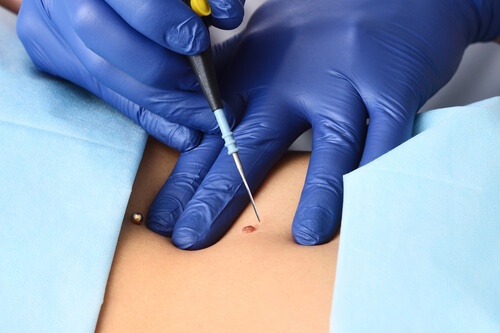
Dermato-surgery encompasses surgical procedures performed by a dermatologist for conditions requiring surgical intervention — including lesion excision, skin biopsy, and minor reconstructive procedures. These procedures require the dual expertise of a trained surgeon and a specialist who understands skin biology, scarring, and wound healing at a specialist level.
At Dr. More’s clinic, all procedures are performed under local anaesthesia in a fully equipped, sterile minor OT environment. Every lesion undergoes thorough clinical assessment before any incision. Cosmetic outcome is planned from the moment of the first cut — not considered as an afterthought.
Skin · Nails · Scalp · Face & Body
Complete range of minor dermatological surgical procedures — all performed by Dr Prratyush More in a fully sterile clinical environment.
― PROCEDURES WE PERFORM
Dermato-Surgical Procedures
From simple skin tag removal to complex keloid management — all dermatological surgical procedures performed with specialist precision and cosmetic consideration.
Sebaceous & Epidermoid Cyst Excision
Complete surgical removal — only definitive treatment.
Sebaceous & Epidermoid Cyst Excision
Complete surgical excision of the cyst sac is the only definitive treatment preventing recurrence. Partial removal or aspiration leads to rapid recurrence. Dr. More excises the entire cyst wall under local anaesthesia in a single session, with closure designed for minimal scarring.
Mole Removal & Skin Biopsy
Mole Removal & Skin Biopsy
Benign moles can be removed for cosmetic reasons using shave excision or punch excision with optimal cosmetic outcome.
Skin Tag Removal
Quick, painless removal by electrocautery or excision.
Skin Tag Removal
Skin tags removed quickly and effectively using electrocautery or scissors excision under topical or local anaesthesia. Multiple skin tags can be treated in a single session. Procedure takes minutes with immediate results and no downtime.
Wart & Molluscum Treatment
Electrocautery, radiofrequency or chemical destruction.
Wart & Molluscum Treatment
Electrocautery, radiofrequency ablation, cryotherapy, or chemical destruction — treatment selected based on wart type, location, and patient age. Multiple warts treated in a single session where appropriate. Recalcitrant or recurrent warts addressed with combination approaches.
Keloid & Hypertrophic Scar Treatment
Multimodal — topical medications plus corticosteroid injections.
Keloid & Hypertrophic Scar Treatment
Multimodal approach: surgical excision combined with intralesional corticosteroid injection and post-operative silicone sheeting. Keloids have high recurrence after excision alone — combination treatment significantly reduces this risk. Dr. More plans treatment based on lesion size, site, and patient response history.
Corn & Callus Treatment
Precise debridement and pressure redistribution.
Corn & Callus Treatment
Painful plantar corns and calluses are treated by precise surgical debridement under local anaesthesia where required. The underlying pressure point is identified and addressed with appropriate footwear advice and padding. Recalcitrant corns may require enucleation of the central core for lasting relief.
Milium & Syringoma Removal
Electrocautery or radiofrequency — precise, scar-free.
Milium & Syringoma Removal
Milia (small white keratin cysts) and syringomas (benign sweat duct tumours) around the eyes and face are removed using fine electrocautery or radiofrequency — precisely targeting lesions with minimal surrounding tissue damage. Results are cosmetically excellent with very low recurrence.
― OUR PROCESS
How Every Surgical Procedure Is Planned & Delivered?
A rigorous, safety-first surgical process — from clinical pre-assessment to post-operative scar management.
01
Pre-Surgical Assessment
Clinical Evaluation & Assessment
Every lesion is evaluated clinically before any procedure. This allows Dr. More to assess the nature of the lesion — particularly important for pigmented lesions — and plan the appropriate procedure, margin, and closure technique. No surgery without a thorough pre-operative assessment.
02
Preparation
Sterile Setup & Local Anaesthesia
All procedures performed in a fully sterile minor procedure room. Local anaesthesia administered to achieve complete pain-free anaesthesia before any incision. Informed consent obtained and documented before every procedure.
03
Procedure
Precise Surgical Excision
Technique selected based on lesion type, size, depth, location, and cosmetic consideration. Complete excision with appropriate margins. Closure planned for optimal cosmetic outcome based on the anatomical site. Specimen retained for histopathology when clinically indicated.
04
Histopathology
Specimen Sent for Histopathology When Indicated
Any excised tissue with diagnostic uncertainty is sent for histopathological examination to ensure accurate diagnosis. This is particularly important for pigmented lesions, unusual growths, or any lesion where malignancy cannot be excluded clinically. Results are explained clearly at the follow-up visit.
05
Post-Operative Care
Wound Care & Scar Management
Written wound care instructions, and post-operative scar management guidance are provided on the day of surgery. Scar management (silicone sheeting, sun protection, topical treatments) is planned proactively from the day of closure.
― SURGICAL OUTCOMES
What You Can Expect?
Realistic surgical outcomes — complete removal, accurate diagnosis, minimal scarring, and prevention of recurrence.
Complete Lesion Removal in a Single Session
For most benign lesions — cysts, skin tags, warts, milia — complete excision is achieved in a single session under local anaesthesia with zero hospitalisation.
Accurate Histopathological Diagnosis
Excised tissue analysed histopathologically where indicated — ensuring any unexpected finding is identified and appropriate follow-up arranged. No diagnostic uncertainty left unaddressed.
Well-Healed, Minimal Scarring
Careful surgical planning, appropriate closure techniques and structured post-operative scar management produce well-healed wounds with the best possible cosmetic outcome for each site.
Prevention of Recurrence
Complete removal of the entire lesion — including the capsule for cysts — and appropriate adjuvant treatment for keloids significantly reduces recurrence.
― WHY DR. PRRATYUSH MORE
Why Choose Us for Dermato-Surgery?
Certified expertise, clinical assessment, sterile surgical environment, and complete excision — every time.
Specialist Precision.
Cosmetic Awareness.
Dr. Prratyush More applies the dual expertise of certified dermatologist and a trained dermato-surgeon — understanding both the biology of skin and the principles of surgical wound healing. Every procedure is planned with the end result in mind: complete removal, accurate diagnosis, and the best possible cosmetic outcome.
Certified Dermatological Surgeon
Full post-graduate training in dermatological surgical techniques — a dedicated skin specialist, not a general surgeon attempting dermatological procedures. Specialist precision for every lesion.
Clinical Assessment Before Every Pigmented Lesion
Clinical assessment of all pigmented lesions before intervention — distinguishing benign from suspicious, ensuring appropriate margin selection, and avoiding unnecessary excision of clearly benign lesions.
Fully Sterile Minor OT Environment
All procedures performed in a clinical-grade, sterile procedure room with full infection control protocol — not a treatment room adapted for surgery. Proper surgical environment for every procedure.
Cosmetic Outcome Always Considered
Incision placement along relaxed skin tension lines, layered closure, fine suture material, and proactive post-operative scar management — aesthetics are planned from the moment of the incision.
Complete Excision — Not Partial Removal
Incomplete removal of cysts or keloids leads to rapid recurrence. Complete lesion excision — including capsule for cysts — is the standard at every procedure. No shortcuts.
Histopathological Confirmation When Indicated
Excised tissue sent for pathological examination when clinically appropriate — ensuring accurate diagnosis, detecting incidental malignancy, and providing documented clinical evidence for every patient.
― COMMON QUESTIONS
Frequently Asked Questions
Answers to the questions patients ask most frequently about dermato-surgical procedures at our clinic.
Is the surgical procedure painful?
Local anaesthesia is administered before every procedure — the surgical site is completely numb before any incision is made. The administration of local anaesthetic itself involves a brief stinging sensation. For nail procedures, a digital nerve block is used to ensure complete, reliable anaesthesia. Post-procedure discomfort is mild and managed with standard oral analgesics for 24–48 hours.
Will there be a visible scar?
Any incision through full-thickness skin will leave a scar. The goal of dermato-surgical technique is ensuring that scar is as fine, flat, and well-faded as possible. Dr. More plans incisions along natural skin tension lines, uses layered suturing, and provides comprehensive post-operative scar management. Most well-executed dermato-surgical scars are barely visible at 6–12 months.
How long does it take for the wound to heal?
Small excisions typically heal within 7–14 days, with suture removal at 7–14 days depending on anatomical site. Larger excisions may take 3–4 weeks for initial healing and 3–6 months for scar maturation. Specific healing timelines are discussed at your pre-operative consultation so you can plan accordingly.
I have a cyst that keeps getting infected — what should I do?
An actively infected cyst should not be excised acutely — infection increases complication risk and makes complete excision more difficult. The correct management is incision and drainage of the acute infection, followed by a planned excision of the entire cyst 4–6 weeks later when the inflammation has fully resolved. Dr. More manages both stages of this process.
Can skin tags be removed without surgery?
Yes. Skin tags are effectively treated with electrocautery or radiofrequency ablation under topical anaesthesia — no surgical incision required. Multiple skin tags can be treated in a single session. Larger or atypical skin tags may be excised rather than cauterised for histopathological confirmation that they are benign.
Do keloids grow back after surgery?
Keloids have a high recurrence rate after simple surgical excision alone — which is why surgery alone is inadequate for keloid management. Dr. More uses a multimodal approach: surgical excision combined with immediate intralesional corticosteroid injection and post-operative silicone sheeting. This combination significantly reduces recurrence. Site, size, and patient history all influence the protocol.
Do I need to take time off work after a dermato-surgical procedure?
Most minor procedures — mole removal, skin tag excision, milia removal — require no time off work. Patients return to light activity the same day. Larger excisions on mobile areas (joints, neck) may require 1–2 days of reduced activity to protect the wound. Specific activity restrictions are documented and provided in writing on the day of surgery.
Is histopathology (biopsy) always required for removed lesions?
Not for all lesions. Clearly benign lesions with characteristic clinical and dermoscopic features — typical skin tags, milia, lipomas with characteristic feel — may not require routine histopathology. Any lesion with features of diagnostic uncertainty, unusual appearance, or pigmented nature is sent for histopathological examination. Dr. More explains at consultation which category your lesion falls into.
― Patient Stories
Trusted by Our Patients
Real experiences from real patients in Thane. Here’s what they say about their journey with Dr. Prratyush More.